Structure of the I CHING HEXAGRAM
MYTHLE S

T'ai Chi
Yang line
Yin line
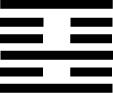
Example of a HEXAGRAM Lines
#22: Adornment
6 *
5
4
3
2 *
1
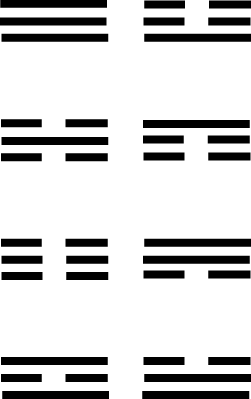
The Eight TRIGAMS
HEAVEN THUNDER
( Force ) ( Arousing )
WATER MOUNTAIN
( Difficulty ) ( Stopping )
EARTH WIND
( Yielding ) ( Entering )
FIRE LAKE
( Intelligence ) ( Openness )
Each hexagram is also understood as composed of two Trigrams (figures of three lines). The two component trigrams (known as "Above" and "Below") are made up of the top three lines and the bottom three lines of the hexagram. These indicate the outer (above) and inner (below) aspects of the situation described in the hexagram. There are 8 possible trigrams. Each of these also has a traditional meaning. Hexagram 22 (shown above) is therefore made up of Mountain (above), and Fire (below)Additional trigrams, made up of lines 2,3,4 and 3,4,5 of a hexagram, are also understood to form a nuclear hexagram that gives further insight into the meaning of each hexagram. The nuclear hexagram for Hexagram 22 (Adornment) is therefore made up of Thunder (above) and Water (below). The nuclear hexagram is believed to indicate something of the original hexagram's contrary or shadow qualities. The shadow (nuclear hexagram) of 22 (Adornment) is 40 ( Liberation). All this will become much clearer as you begin to use the I Ching.Each hexagram also has one or two governing or Ruling Lines. These are pivotal in the structure and dynamics of the hexagram and generally represent auspicious qualities. Most commonly, line 5 is a ruler but sometimes other lines take precedence. For Hexagram 22 (Adornment), the ruling lines are 2 and 6 (indicated by asterisks above).
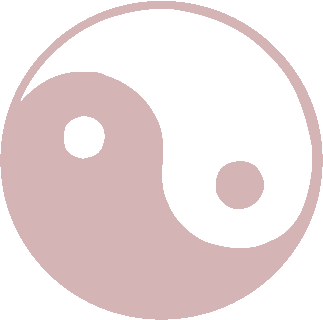
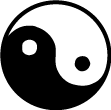
When Yin and Yang are in balanced relationship, then life is harmonious. When we follow a harmonious and connected path through life, then we are said to live in accordance with the Tao. There is also a reality beyond Yin and Yang. This is T'ai Chi (The Absolute).
The TAO of
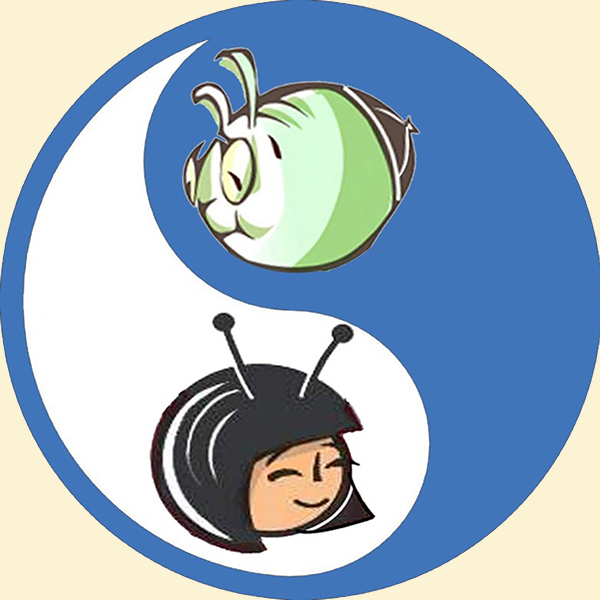
(Mythles meet the I-CHING)
The I-Ching is an ancient book of divination and wisdom. So much of what is great and significant in Chinese cultural history takes inspiration from that text. Think of it as a guide or path for life—the Tao. Concepts of the Trinity, Heaven, Earth and Man, the Yin and Yang, balance and harmony, positive and negative forces, good fortune and misfortune, are all derived from interpretations and commentaries of that book’s use of 64 symbols called Hexagrams. However, I’m more interested in the principles of I-Ching, not the practice. My ‘Fairly’ Tales were composed years before I knew anything about Chinese philosophy or the Tao, that’s why it is the attributes of these 64 Hexagrams that involve me and my 64 Mythles. The similarities between them are striking.
* * *
The whole concept of natural law and immutable change is what moved me to include this
I-Ching page on my website. Mythles were created initially to supply an insecure child who liked to draw with a more orderly and manageable world. Only in adulthood did I realize the need for security is lifelong. And 3,000 years ago someone in China had the foresight to create his own Mythlewild.
Just keep reading if you care to learn more!
Philophically, I ‘Kant’ compete with the great intellects of western thought.
However, since my wife, Shana, is Chinese (and a great home decorator) she let me flip through her “Feng Shui” book once---so I can speak with some expertise on the subject of Taoism.
It was on the pages of Shana’s book that I first came across the 64 Hexagrams of the Chinese Book of Changes, the” I CHING". Once I discovered the origins of the I CHING go back to mythical antiquity, I was hooked. Unfortunately, discussing such a profound work requires more insight than a mere attraction to the word “mythical”. So let me acknowledge the real experts: Lillian Too, Mary Clark, Richard Craze, and Michael Daniels PhD, whose websites and books provided much of information on this page.
Taoism, the ancient religion / philosophy of China, provides a vivid explanation of these symbols. The early Taoists believed that originally there was ONE, the universe, and that out of the universe heaven and earth were created. Heaven would be represented by a single unbroken line (YANG). Earth would be represented by a broken line (YIN). These TWO lines represent everything in creation, what we Westerners know as YIN and YANG. Some YIN attributes are: earth, negative, female, night, winter, etc. YANG attributes would be the opposite: heaven, positive, male, day, summer, etc. This concept that all things are created from a mixture of opposites lies at the heart of Chinese philosophy.
Although they represent opposites, YIN and YANG are not in opposition. Taoists believe that there is an energy---CHI---flowing constantly between the two. Everything is in a constant state of flux between these two polarities. Just as day follows night, YANG will inevitably follow YIN. Taoists further believed that this cycle of life was not to be acted upon, but joined with. We should work with rather than against the natural order of the world.
It follows naturally, that from the two---come THREE. And so a third line creates the TRIGRAM. These forms in turn produce EIGHT Trigrams (the maximum number of combinations of the 3 lines). For Taoists, these eight represented everything in the universe---the TAI CHI (“great force”). Their arrangement into an octagon is known as the “PA KUA” (great symbol).
There are 64 possible combinations of these 8 Trigrams, and it is the arrangement of these 64 basic symbols, called HEXAGRAMS, and their respective interpretations, that form the body of the Book of Changes.
Note: There is much significance attached to the number 8 ... Click it and see!
Yang and Yin are represented in the I Ching by unbroken and broken lines.
When using the I Ching oracle, these lines are used to create Hexagrams (figures made up of six lines). Hexagrams are always constructed and read from the bottom to the top. Each line in a hexagram can be either Yang or Yin. The various combinations give rise to 64 different hexagrams. For the purposes of the divination, each different hexagram (and every line in a hexagram) has its own particular oracular meaning.
The central idea behind the I Ching is that of flux or change. All things, including human affairs, are understood to change through time - they are born, develop, decay, die and are reborn in some new form. By studying these changes, we can recognise significant patterns of change (e.g., night and day, the phases of the moon, the seasons of the year, the ages of man). Change also involves relationships between opposites. The two most basic opposites are the principles of Yang and Yin. Yang corresponds to active, creative, expansive force. Yin corresponds to receptive, mutable, contracting form. All change can be understood in terms of the relationship between Yang and Yin.
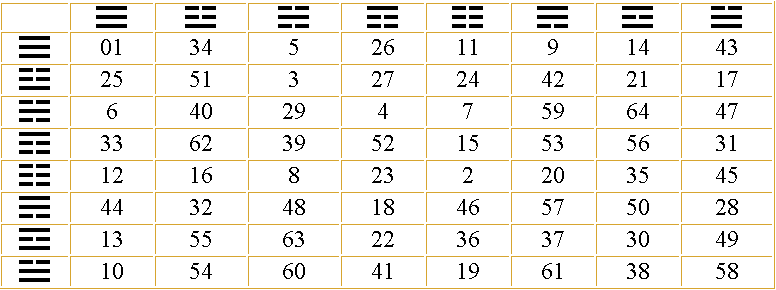
The chart below shows how the trigrams combine to form the 64 hexagrams. The upper trigrams are listed on top, and the lower trigrams on the left.







© copyright 2008